
The Music Continues 🎻
Interested in subscribing? Call our box office at 270-904-1880 to learn more.
Single tickets for the 2026–2027 Orchestra Kentucky season are available now — purchase below.
Upcoming Events:


Orchestra Kentucky: The Everly Brothers Experience Featuring The Zmed Brothers

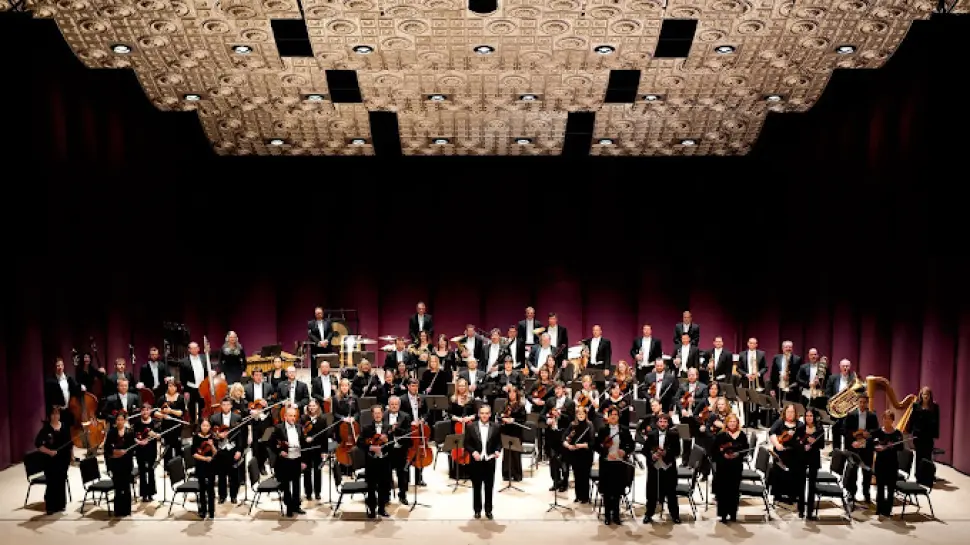
Orchestra Kentucky History
Orchestra Kentucky was founded in the summer of 2000 with no money, no concert hall, and no guarantee that the idea would succeed, only the vision of two friends, Jeff Reed and Mike Thurman. Both musicians, they believed Bowling Green and the surrounding region needed a professional orchestra of its own.
Reed and Thurman gathered a small group of friends to explore the idea: Duncan McKenzie, Evan Walters, Chuck and Janet Smith, and Greg and Helen Motter. After several meetings, the group decided to move forward. Reed became music director, Thurman was elected president, Chuck Smith treasurer, and Helen Motter secretary. Because the ensemble was initially modest in size, the organization was named the Bowling Green Chamber Orchestra.
Local musicians were recruited and rehearsed on Monday evenings at Royal Music Company for several weeks before the orchestra gave its inaugural concert on September 11, 2000, at Christ Episcopal Church in Bowling Green. Approximately 150 people attended a program featuring music by Wagner, Handel, and Mozart.
Republic Bank and Jim Johnson provided crucial financial support to launch the organization, while several musicians agreed to perform without compensation. During that first season, the founders secured enough funding to continue, wrote a constitution, incorporated the organization, obtained 501(c)(3) nonprofit status, and established goals for the future. The orchestra was on its way.
As the ensemble grew in size, audience, and geographic reach, its identity evolved as well. On January 22, 2009, the Bowling Green Chamber Orchestra officially became Orchestra Kentucky, a name that reflected its transformation from a small local ensemble into a professional orchestra serving a much broader region.
A Different Kind of Orchestra
One of the most important milestones in Orchestra Kentucky’s development was the decision to put a rock band and vocalists on stage with the orchestra. Reed assembled a group of local rock musicians, later named The Rewinders, and Pam Thurman and Chuck Smith helped transcribe orchestral parts for the new format.
The first Beatles concert sold approximately 450 tickets. By the sixth year, nearly 2,000 tickets were sold for the program. Its success led to additional rock, pop, and crossover productions and helped establish what would become one of Orchestra Kentucky’s defining characteristics: an orchestra equally comfortable with Beethoven, Broadway, the Beatles, bluegrass, and American popular music.
The Rewinders themselves developed a following well beyond Bowling Green, performing in Alabama, California, Georgia, Indiana, Iowa, Kentucky, Maine, Nebraska, North Carolina, South Carolina, and Tennessee. This willingness to challenge traditional assumptions about what an orchestra should perform became central to Orchestra Kentucky’s identity and growth.
Growth and a Permanent Home
The 2001–2002 season was the first in which the orchestra offered season tickets. Fifty-nine were sold. Subscription sales grew steadily in the years that followed, surpassing 1,200 during the 2018–2019 season and eventually growing to more than 1,500 subscribers.
The organization’s budget grew just as dramatically, from approximately $30,000 in its second year to nearly $1.3 million before Orchestra Kentucky merged with the SKYPAC Foundation and became part of the organization now known as SKYPAC.
The opening of the Southern Kentucky Performing Arts Center provided Orchestra Kentucky with the professional concert home envisioned by its founders. What began before audiences of 150 to 200 people developed into an orchestra regularly performing for houses approaching 80 percent of capacity.
Orchestra Kentucky has also taken its music beyond Bowling Green, performing in communities including Russellville, Scottsville, Glasgow, Hopkinsville, Madisonville, and Somerset.
Education and Community Engagement
Education has been part of Orchestra Kentucky’s mission almost from the beginning. A youth orchestra was established in 2001, followed by the String Academy in January 2003. At its peak, the String Academy served as many as 130 students with a faculty of seven teachers and played an important role in providing string instruction at a time when such opportunities were limited in the community.
As string programs became established in the local public schools, the need for Orchestra Kentucky to provide separate beginning string instruction diminished, and the String Academy was discontinued. Its closure reflected a positive development: string education had become more widely available to students through the public school system.
Orchestra Kentucky continues its commitment to developing young musicians through its youth orchestra program, which has included approximately 70 student musicians.
Over the years, Orchestra Kentucky has experimented with numerous ways to introduce young people and families to orchestral music. During the 2005–2006 season, the orchestra introduced its C-3 Children’s Cushion Concerts at Bowling Green’s historic train depot. Designed for children ages two through nine, the concerts featured Perry Penguin, Orchestra Kentucky’s mascot, who traditionally led the children in a parade.
The Young at Art series followed in 2009–2010, offering programming for families and “anyone else who feels like a kid.” Those programs eventually evolved into school-day performances and other family and educational initiatives.
Adult education has also remained important. Pre-Concert Chats with the Maestro have given audiences additional insight into the music they are about to hear, while orchestra representatives have presented programs for civic organizations, retirement communities, and other groups throughout the region.
A Community Tradition
In 2005, Orchestra Kentucky presented the first free Fourth of July Star-Spangled Spectacular on the campus of Western Kentucky University near Guthrie Tower. The combination of live orchestral music and fireworks became an annual community tradition for several years, attracting crowds that eventually exceeded 15,000.
Also in 2005, supporters established The Encore to provide volunteer and financial support for the orchestra. Among its most successful projects was the 2007 Notable Art event, which raised more than $40,000 through the auction of artistically decorated musical instruments. The Encore also organized fundraising events surrounding appearances by artists including The Lettermen and Glen Campbell.
From Founder to the Next Generation
For Orchestra Kentucky’s first quarter-century, its artistic identity was shaped by founding Music Director Jeffrey Reed. Reed’s philosophy was straightforward: orchestral music could entertain as well as educate.
Rather than requiring audiences to come to the orchestra entirely on the orchestra’s terms, Reed believed the orchestra should meet audiences where they were and then take them somewhere new. Familiar classical masterpieces appeared alongside Broadway, film music, rock, pop, bluegrass, and other American musical traditions.
Audiences might come to hear music they already loved, but along the way they would encounter something they had never heard before. That philosophy helped transform an orchestra that began with approximately 150 people in a church into one of South Central Kentucky’s most established cultural institutions.
During his 25 years as music director, Reed’s work with Orchestra Kentucky became the foundation for a broader conducting career. He conducted orchestras in Detroit, Indianapolis, Nashville, South Korea, Milan, and St. Petersburg, and twice conducted the Royal Philharmonic Orchestra at London’s Royal Albert Hall.
Bestselling author and marketer Seth Godin highlighted Reed in Small Is the New Big, praising his “clever” concerts and his “totally different way” of approaching programming. Reed also conducted for Neil Sedaka and Mary Wilson of the Supremes and worked with artists including Air Supply, B.J. Thomas, Larry Gatlin, Paul Williams, Jimmy Webb, Peter Tork, Glen Campbell, Keith Emerson, Marilyn McCoo and Billy Davis Jr., Melissa Manchester, Chris Young, Sara Evans, Matthew Morrison, Bill Gaither, Sandi Patty, and Larnelle Harris.
Reed’s contributions to music and the community have also received significant recognition. The University of Louisville named him its 2015 Alumni Fellow for the School of Music, and he received the Jefferson Award for public service in South Central Kentucky in 2008 and the Governor’s Award in the Arts.
Drawing on his legal education and experience, Reed became president and CEO in 2020 of the nonprofit organization that manages SKYPAC, extending his leadership from the podium to the broader performing arts organization.
In 2026, Orchestra Kentucky entered the second major artistic era in its history with the appointment of Joseph L. Trafton Jr. as Music Director. Succeeding Jeff Reed in the role, Trafton now holds the Jeffrey A. Reed Chair.
For Trafton, the appointment represented a homecoming. A Bowling Green native and graduate of Warren Central High School, he earned his master’s degree in conducting from the Eastman School of Music before building an international career that included more than two decades in Germany. He served for eight seasons as Music Director of Theater Hagen, conducting opera, symphonic repertoire, ballet, and musical theater.
Trafton returned to Bowling Green as a guest conductor for Carousel in April 2026 before being selected to lead both Orchestra Kentucky and Ramsey Theatre Company. His appointment brought international conducting experience back to the community where his musical life began.
His first Orchestra Kentucky season represents both continuity and change. The orchestra remains committed to the accessible, audience-centered programming that fueled its growth while entering a new period of artistic development under a conductor with extensive European symphonic and theatrical experience.
Reed continues as President & CEO of SKYPAC, providing organizational continuity while transferring artistic leadership of the orchestra he founded to the next generation.
The Next Chapter
More than a quarter-century after its founding, Orchestra Kentucky is still guided by the principle that distinguished it from the beginning: the audience matters.
Its success has never depended on choosing between artistic quality and popular appeal. Instead, Orchestra Kentucky has sought to bring the two together, presenting great classical music while embracing Broadway, rock, pop, film music, and other genres capable of introducing new audiences to the power of a live orchestra.
What began in 2000 as an idea shared by two friends has grown into a professional orchestra with a permanent home, a substantial subscriber base, educational programs, a youth orchestra, and a tradition of performances that reach far beyond the concert hall.
With Joseph Trafton beginning a new era of artistic leadership and Jeffrey Reed continuing to lead SKYPAC, Orchestra Kentucky now has the opportunity to build on its founding philosophy while expanding its artistic ambitions for a new generation.
Its mission remains as relevant as it was at the beginning:
“Changing lives . . . one note at a time.”
Orchestra Personnel
Music Director, Orchestra Kentucky & Ramsey Theatre Company
Jeffrey A. Reed Chair
First Violin
Beverly Drukker | guest concertmaster
Kirsten Mitchell
Kameron Myers
Melissa Bull
Deidre Bacco
Jessica Miracle
Rebecca Neely
Steven Kinnamon
Jocelyn Sprouse
Emilia Carter
Nathan Jones
Second Violin
Lacy Jean
Mary Grace Reed
Paula Manrique
Drew Sarette
Morgan Maassel
Philip Scherer
Marina Fisher
Becca Major
Viola
Claire Whitcomb
Elizabeth Jones
Bergen Christensen
Anne Warner
Darrell Merryman
Guanliang Zong
Cello
Sarah Berry
Ian Schroeder
Harrison Reed
Rebecca Price
John Marietta
Abbye Allan
Bass
Gregory Olson
David Messina
Tim Pearson
Patrick O’Rourke
Flute
Heidi Alvarez
Piccolo
Oboe
Pamela Thurman
English Horn
Clarinet
Marilyn Nije
Bass Clarinet
Bassoon
Patricia Gunter
Contrabassoon
Saxophone
Robby Shankle
Andy Robinson
Matt Davich
Horn
Michael Thurman
Jon Gustely
Kristen Sienkiewicz
Trumpet
Jonathan Stites
Sarah Herbert
Trombone
Bill Huber
Bass Trombone
Tuba
Timpani
Percussion
Marty Sharer
Webb Hendrix
Harp
Keyboards
Personnel Manager
Librarian
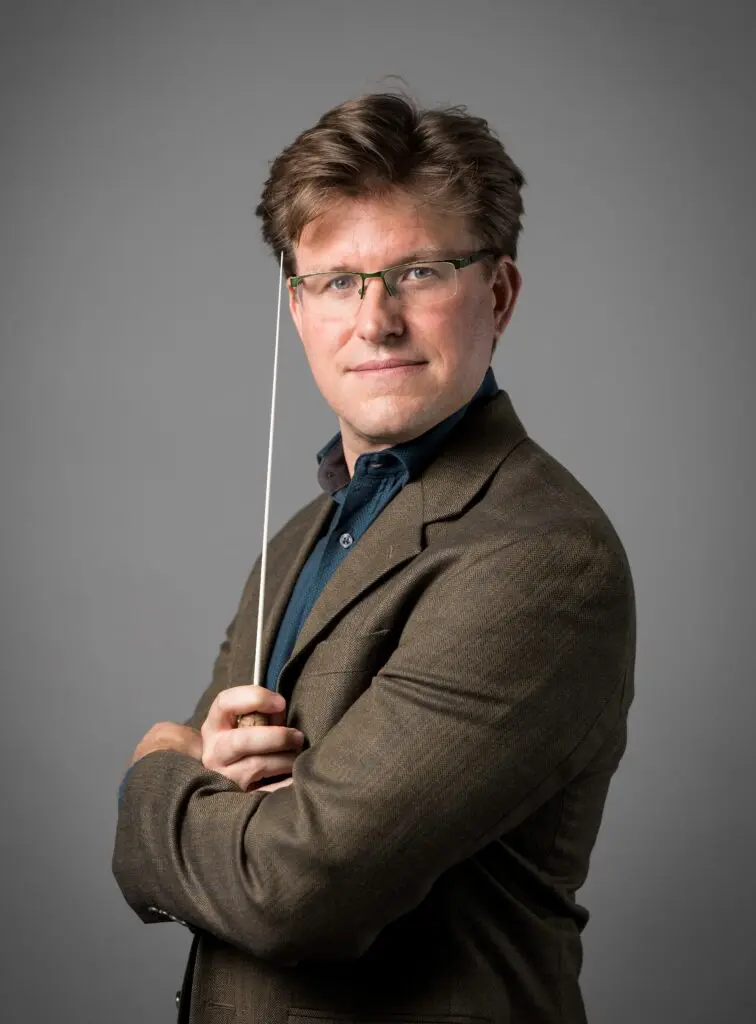
Meet the Maestro:
Joseph L. Trafton, Jr.
His symphonic work spans the entire core repertoire, from Bach and Vivaldi through 19th-century masters to living composers such as Mason Bates, Jennifer Higdon and John Adams. He has conducted the complete Beethoven and Brahms symphonies and numerous symphonies of Mahler and Bruckner, and he returns again and again to the Russians — Tchaikovsky, Rachmaninoff, and Shostakovich — music he cares about deeply.
Trafton builds bridges across genres, from the symphonies to Video Games Music in Concert. He has conducted Les Misérables, My Fair Lady, Jesus Christ Superstar, and Fiddler on the Roof, as well crossover programs like Beethoven vs. Coldplay — and, from the opera pit, Bizet's Carmen, Puccini's La Bohème and Madama Butterfly, and Wagner's Tristan und Isolde.
He made his German debut in 1999 with Cyrano – The Musical, then held posts at the theatres in Regensburg and Braunschweig and as First Kapellmeister at the Nationaltheater Mannheim, before becoming Music Director of the Hagen Philharmonic Orchestra in 2017.
He has guest conducted across Austria, the Czech Republic, Finland, France, Switzerland, and Germany, leading orchestras including the Basel Symphony, the Baden-Baden Philharmonic, and the Oldenburg State Orchestra, and has worked with soloists including Steven Isserlis, Anna Vinnitskaya, and Joseph Alessi. A composer himself and a longtime advocate for new music, he has led world premieres at Wien Modern (Vienna), the Savonlinna Festival (Finland), Festival Musica (Strasbourg), Ostrava Days (Czech Republic).
Trafton studied conducting and composition in Miami, Vienna, and at the Eastman School of Music, and worked in masterclasses with Bernard Haitink and Pierre Boulez. Studies with Paul O'Dette and Malcolm Bilson began a lasting interest in historically informed performance; he recently conducted Mozart's Don Giovanni from the fortepiano, with the Hagen orchestra playing period brass and timpani, and Bach's St. Matthew Passion at Cologne Philharmonic Hall.
Teaching has run through the whole of his career — youth and conservatory orchestras in Mannheim, Iserlohn, and Passau among them, and now Upbeat, where he leads group music-making for children who might not otherwise have access to it.